
Zadok the Preist.
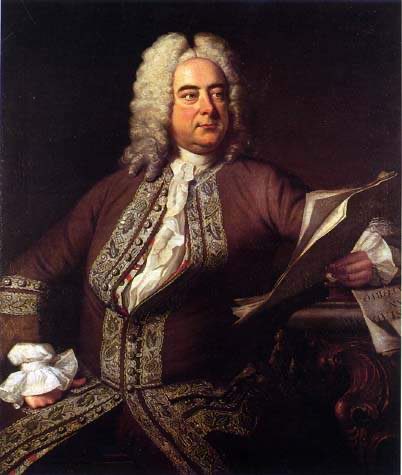
Handel is one of the most important composers of the high baroque period. He was born 1685 and brought up in Halle, Germany. Later he worked in Hamburg and Italy, before settling in London where he dominated English music until long after his death in 1759.
Handel’s music is perhaps the most approachable of all baroque composers and this has rightly made him a household name and sound for most people, be it the Hallelujah Chorus, Zadok or the Water music… to name but three…
He so many of his contemporaries, he wrote prolifically, including many operas and oratorios, as well as large volumes of instrumental pieces including Concerti Grossi and Sonatas.
- 19 parts.
- Composer : Georg Friderick Handel
- Period: Baroque
- Difficulty : Easy to Tricky
- Instruments:
- Descant
- Treble
- Tenor
- Bass
- Great
- Contra
Notes
Written in 1727 for the coronation of Goerge II, this anthem has been part of the coronation ritual ever since and is one of Handel’s most loved pieces.
To celebrate the coronation of Charles III, consorts has produced an arrangement for recorders and like the coronation itself, there should be something for everyone to enjoy and play.
We have transposed the piece from D Major into C major, as it removes the issue of lots of top C# and F# in the most tricky parts… which would have made the whole piece very difficult indeed!
With the exception of the timpani, all parts have been transcribed, although content has been moved around from one part to another in order to make it more playable and to cope with the much wider range of the string instruments, which far exceed the range of a recorder.
The easiest parts are those which follow the original brass parts… Descant 3 and 4 and Treble 2…. The notes are relative simple and the range not too great… an ideal option for those who are either not great sight readers or are just less experienced. The typical tonic/dominant notes are actually quite fun to play too as they provide a real emphasis to the music.
At an intermediate level, the choral parts. Descant 1 and 2, Treble 1, Tenor 1and 2, Bass 1 and 2 are more challenging, but not too difficult. They include a lot of very vertical harmony which will help with counting… with one or two short sections of quicker passage work, but these actually fit under the fingers quite well.
For those who want a challenge, the parts derived from the remaining orchestral parts are the most difficult. Lots of semiquavers and not always the easiest to play! If you tackle these parts, you will not only need to be able to read and play fast, but will also need to carefully plan breaths!
Music Copies
This arrangement is exclusive to Consorts.
Click the links to download the score and parts.