
Motet - Spem in Allium

Notes
Spem in Allium is probably the best known of Tallis’s compositions, not because it is necessarily his best, but simply because of the sheer scale of the piece. It is written for 4, double, five part choirs. The music fits the range of an 8 foot ensemble of recorders perfectly and the soundscape varies from moments where only one part is playing to incredibly thick textures where all 40 combine using every possible pitch and rhythmic variant possible within the limitations of renaissance tonality.
In this version, we have provided every single part as selectable part to play. If you do try it… make sure you use some decent quality loudspeakers at a reasonable volume, so that your part will blend with the other 39!
In terms of playing this piece, the notes are very easy and anyone should be able to play it with little problem… however, the rests are probably more tricky! No part plays more than 60% of the time and the parts switch seamlessly between on and off beat phrase, often in the same sequence, so accurate counting is essential. Add to that, the relatively static nature of 40 polyphonic parts and the thickness and complexity of the textures, the perceived wrong notes caused by his signature false relations and it is very, very easy to get hopelessly lost!
Thomas Tallis is probably one of the most significant composers of the renaissance period, however, we very little about him… even the well known picture of him (opposite) is a fictional representation painted more than a century later!
Probably born in East Kent in the early years of the 16th century, he may have been educated at Dover Priory, sung at Canterbury Cathedral or possibly even been a chorister at the Chapel Royal… scholars can only speculate!
As a young man is he worked as a singer and organist at a variety of monastic institutions, including Dover and Canterbury, before moving to London.
He served as a singer organist and composer to successive monarchs from Henry VIII thought to Elizabeth I. A turbulent time of reformation, the introduction of protestantism and various persecutions of both catholics and protestants by successive monarchs. Somehow, Tallis managed to keep his faith private, remain a catholic and yet still find favour and patronage following the dissolution of the monasteries.
One of the most significant features of his music is his use of false relations, where accidentals are added in one part without appearing in another… a tradition which has permeated English music from Dunstable to Vaughan Williams and on to the present day.
- 40 parts
- Composer: Thomas Tallis
- Period: Renaissance
- Difficulty: Easy/Moderate
- Instruments:
- Tenor (8)
- Bass (8)
- Great Bass (8)
- Contra (16)
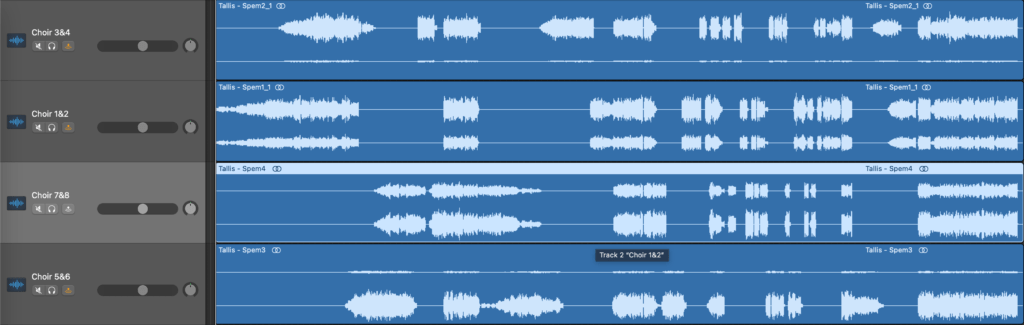
This screenshot shows how the Choirs work independently and together quite well. It comes from our ‘mix down’ which had to be undertaken as 4 seperate items simply because the computer was struggling to handle 40 large audio files simultaneously.
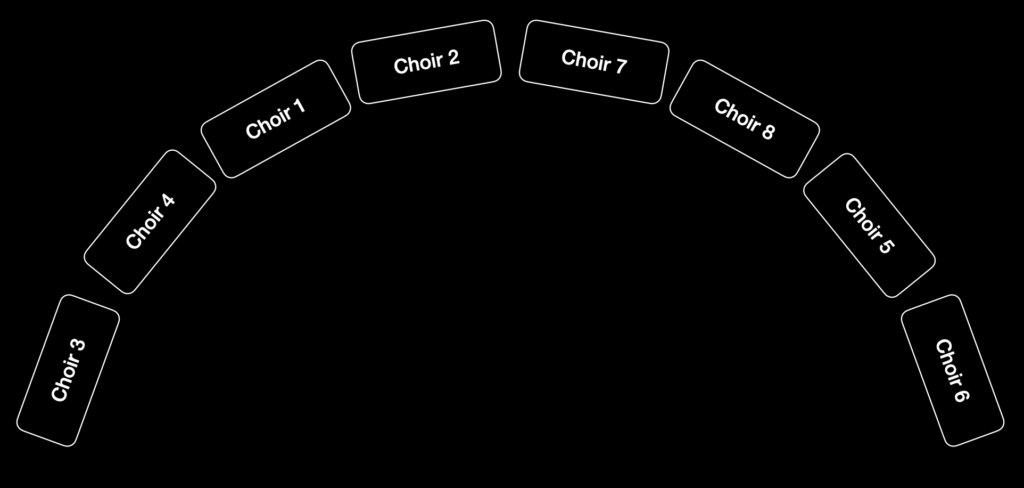
Ideally, a recording or performance of this piece would place choirs N,E,S,W, but with only 2 loud speakers this is not really sensible. Our mix places double choirs 1 & 4 in the mid left and right positions with the 2 and 3 on the outer left and right respectively. This is because 1 and 2 work together a lot, as do 3 and 4… however 1 and 4 also work together at times… however, 2 and 3 only really work together when everyone is playing.
Music
The music is a transcription of the original Tallis manuscript and is in the original key. It comes from IMSLP and links to it a re provided below. The transcription does not provide individual parts as this would make it incredibly difficult to follow and stay right, so two two alternatives are offered.
- 4 double choir scores.
- 5 part books.
There is also a full score available, but reading it on A4 paper or a standard screen is almost impossible with 40 individual lines. Commercially available printed scores use pages well in excess of A2 sized paper and although print is still small, are just about readable, but far from practical because they are so large!
Double Choir Scores
This is what we recommend you use… together with a highlighter pen to help find individual parts on the ten staves… Although not ideal, you can see entries from adjacent parts in your choir and thus gain an valuable aid to supplement your accurate counting!
Part Books
These scores show all 8 parts for Soprano, Alto Tenor Bariton and Bass… Initially we tried using these for our recording, but it quickly became clear that although efficient in terms of printing for an individual instrument, they were much harder to follow and missed vital cues in the adjacent individual choir parts.